The sight of vast solar farms stretching across the landscape, or neat rows of panels adorning rooftops, has become a powerful symbol of our transition to clean energy. It’s easy to look at these silent, motionless arrays and assume they are a "set it and forget it" technology, passively soaking up the sun's rays year after year with little need for intervention.
However, solar panels are sophisticated pieces of technology that can degrade and fail. On average, they suffer an efficiency loss of 0.5% to 1% each year, and a variety of faults—from delamination and corrosion to internal circuit failures—can dramatically accelerate this decline, reducing power output and creating safety risks. This raises a critical question for asset managers: How do you find a single malfunctioning panel in a sea of thousands, or even millions, before it causes a major problem?
The answer lies not on the ground, but in the sky, driven by a powerful combination of drones, thermal imaging, and artificial intelligence. This high-tech solution is revolutionizing how we maintain our renewable energy infrastructure, ensuring it operates at peak performance. This post uncovers the four most surprising and impactful aspects of this vital technology.
- It's Not Just Faster, It's a Revolutionary Leap in Efficiency.
- Traditionally, inspecting a utility-scale solar farm was a monumental task, requiring technicians to walk row by row, often in harsh conditions, to manually inspect panels. This process was slow, labor-intensive, and often limited to spot-checking, meaning many faults could go undetected for months. Drones, however, operate on a completely different timescale.
- Industry field tests show that a drone equipped with a thermal camera can scan 1 megawatt (MW) of panels in approximately 10 minutes, a task that would take 2 to 5 hours on foot. To put that in perspective, a 5 MW solar farm, which could take up to 125 man-hours to inspect manually, can be covered by a drone in about one hour. Studies have found that aerial surveys are up to 70% faster, with one logging a staggering 97% boost in efficiency.
- This allows asset managers to shift from reactive spot-checks to proactive, comprehensive audits of 100% of their assets. By catching nascent faults early, they can maximize energy production, streamline warranty claims, and secure the financial performance and long-term reliability of our growing clean power grid.
- They See in a Spectrum Beyond Human Vision.
- The most critical tool on a solar inspection drone isn't a standard high-resolution camera, but a radiometric thermal (infrared) one. Every object with a temperature above absolute zero emanates infrared radiation, which thermal cameras can see. In a solar panel, faulty or electrically stressed components—such as damaged cells, failing bypass diodes, faulty interconnections, or patterns suggesting Potential-Induced Degradation (PID)—generate excess heat. This creates "hotspots" that are clearly visible in a thermal image. Conversely, entire strings of panels that are offline or underperforming appear cooler than their active neighbors.
- Crucially, the vast majority of these electrical issues are completely invisible to the naked eye. A panel can look perfectly fine while silently losing efficiency or posing a safety risk. Thermal imaging provides a direct, non-destructive way to see the panel's operational health. "...the application of infrared thermography (IRT) technology, which is a reliable, non-destructive, rapid, and cost-effective approach for determining the nature of defects in electrical installations."
- This "superpower" of seeing heat allows for a rapid, non-invasive diagnosis of a panel's health, much like a medical scan for the energy grid. It enables operators to identify and fix small internal problems before they can lead to irreversible damage, power loss, or significant safety hazards.
- The Drone Is Just the Eye; Artificial Intelligence Is the Brain.
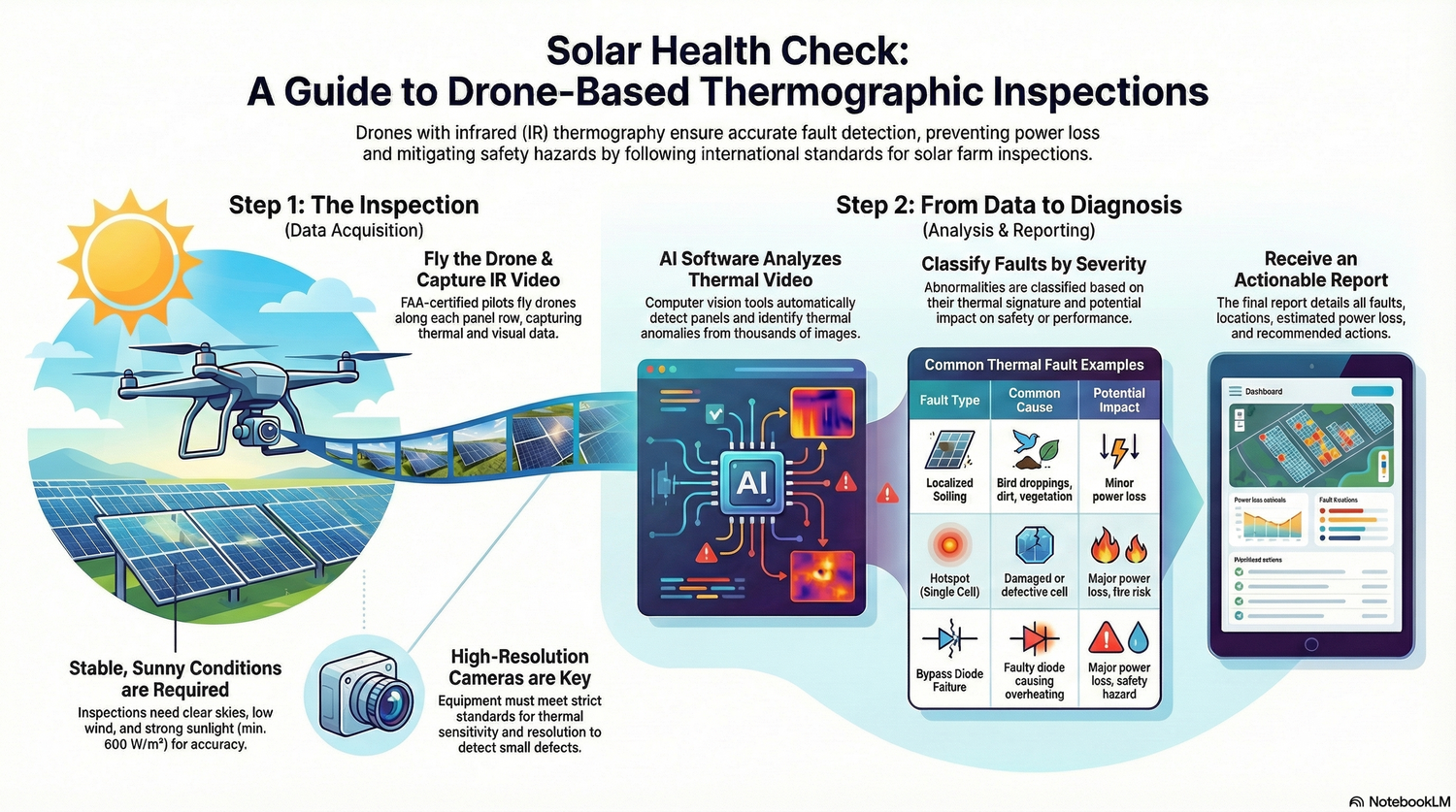
- Flying a drone over a large solar farm is only the first step. A single inspection can generate thousands of high-resolution thermal and visual images, creating a massive data overload. It would be completely impractical and inefficient for human analysts to manually sift through every image to find and classify anomalies. This is where artificial intelligence becomes the engine of the operation.
- AI and deep learning models, such as Convolutional Neural Networks (CNN) and U-Net architectures, are trained to process this flood of visual data automatically. First, the AI identifies and segments each individual solar panel from the aerial imagery, isolating it for analysis. This is often followed by advanced object tracking to associate detections of the same panel across multiple video frames, creating a complete digital record before the final classification of faults occurs. Second, it scrutinizes the thermal patterns on every single panel to automatically detect and classify different types of faults, distinguishing between issues like hotspots, soiling (from dust or snow), shading, and entire string failures.
- The accuracy of these AI models is remarkably high. In one research study, the SqueezeNet model, trained on thermal images to identify panel faults, achieved a testing accuracy of 99.74%. The true innovation, therefore, isn't just in the drone's ability to collect data, but in the intelligent automation that transforms that raw data into a clear, actionable report, telling operators exactly which panel needs attention and why.
- It's a Highly Standardized and Scientific Process.
- Contrary to any image of drone operators flying in an unregulated "wild west," professional solar inspections are conducted with scientific rigor. To ensure that the thermal data collected is accurate and reliable, inspections must follow the IEC 62446-3, an international standard that provides specific guidelines for conducting outdoor infrared thermography of photovoltaic plants.
- The standard outlines strict environmental conditions that must be met to ensure the data is valid. These include:
• Sunlight: Inspections must be conducted when solar irradiance is at least 600 W/m². This ensures the panels are operating under a sufficient load for thermal differences to become visible.
• Wind: Wind speed must be low, and the standard requires avoiding speeds over 28 kph (17 mph). Strong winds can cool the surface of the panels, which can mask the heat signatures of potential faults.
• Cloud Cover: The sky should be clear, with minimal cloud cover (the standard suggests no more than 25%). Passing clouds can cause inconsistent heating and cooling, compromising the integrity of the thermal data.
This level of standardization is essential. It guarantees that the data collected is reliable, repeatable, and credible across different sites and operators. This is critical when the data is used for high-stakes decisions, such as filing warranty claims, satisfying insurance requirements, or authorizing multi-million dollar maintenance and repair projects.
Conclusion: A Smarter, More Resilient Energy Future
Drone-based solar inspections are far more than just flying cameras. They represent a sophisticated fusion of revolutionary speed that enables 100% asset coverage, a superhuman ability to see invisible heat signatures, powerful AI that converts massive datasets into actionable intelligence, and rigorous scientific standards that ensure the data is trustworthy.
This combination of technologies is already working silently in the background to make our solar energy infrastructure more efficient, reliable, and safe. As our world increasingly relies on vast renewable energy infrastructure, it prompts a final question: what other invisible, intelligent technologies will be working behind the scenes to ensure our clean energy future is a reliable one?